
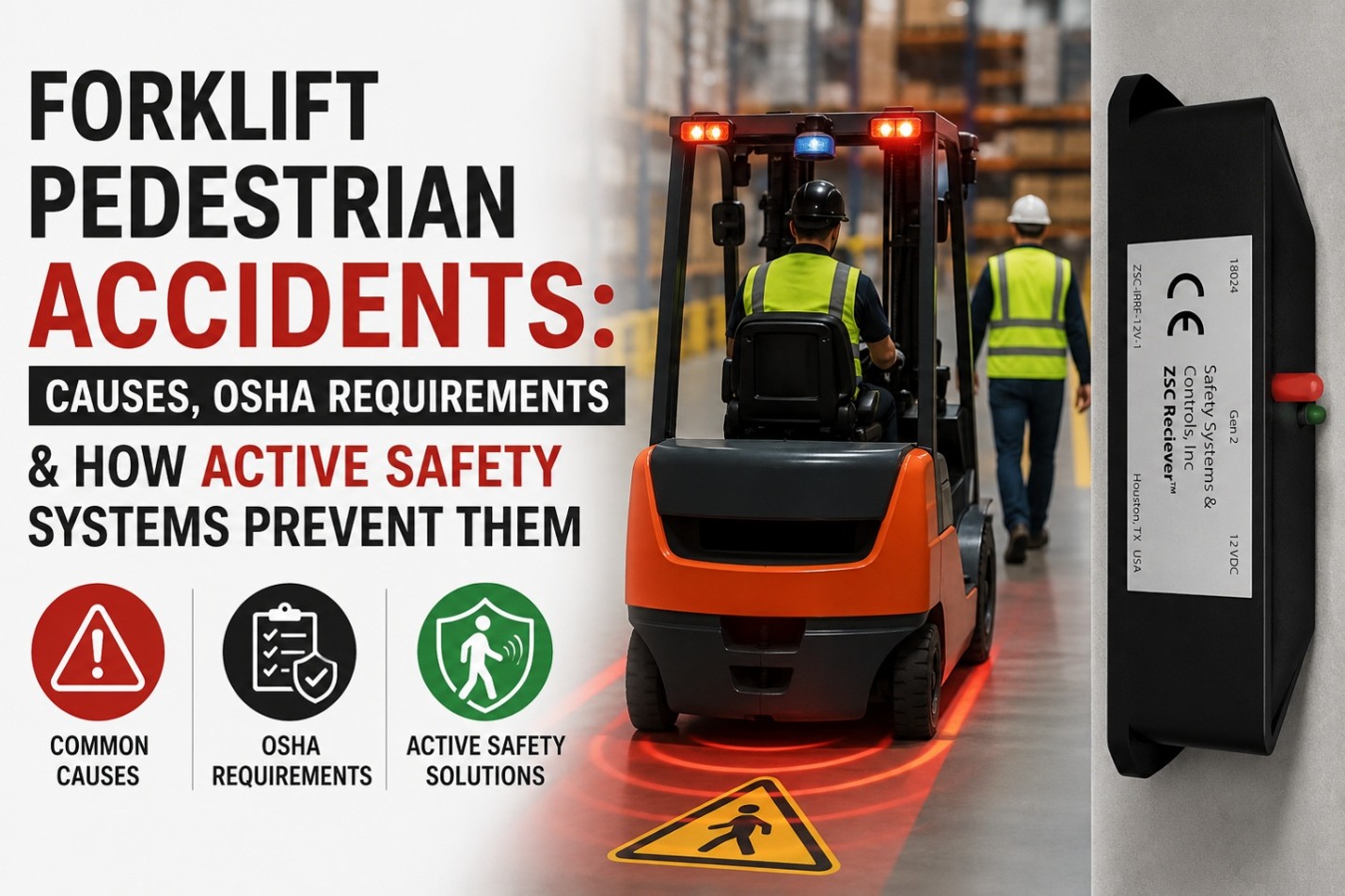
Forklift Pedestrian Accidents: Causes, OSHA Requirements & How Active Safety Systems Prevent Them
Forklifts keep warehouses, manufacturing plants, loading docks, and construction sites moving efficiently every day. However, they also create serious risks when people and powered industrial vehicles share the same workspace. Even a single collision can result in severe injuries, operational delays, equipment damage, and increased safety concerns.
Understanding the causes of these incidents and implementing practical safety measures can significantly reduce workplace risks. This guide explains the common causes of forklift accidents involving pedestrians, outlines important OSHA safety requirements, and highlights how modern active safety technologies help improve forklift pedestrian accident prevention while creating safer and more productive workplaces.
Understanding the Risk of Forklift Pedestrian Accidents
Forklift pedestrian accidents occur when operators and pedestrians occupy the same work area without sufficient controls to separate or protect them. Busy facilities often have workers walking near loading docks, warehouse aisles, storage areas, or production lines where forklifts operate throughout the day.
Several factors make these environments more dangerous:
- Limited visibility around corners and shelving
- Heavy traffic during peak operating hours
- Blind spots created by large loads
- Noise that prevents workers from hearing approaching vehicles
- Inconsistent driving speeds in shared workspaces
When multiple risks combine, the chance of an accident increases considerably. Preventing these incidents requires both safe operating practices and reliable workplace safety systems.
Common Causes of Forklift Pedestrian Accidents
Most accidents happen because several small safety issues occur at the same time rather than from one single mistake.
Some of the most common causes include:
- Operators driving too fast in busy areas
- Pedestrians entering forklift travel paths unexpectedly
- Poor visibility caused by stored materials or equipment
- Congested warehouse layouts with mixed traffic
- Lack of designated pedestrian walkways
- Distracted operators or workers
- Failure to slow down near intersections and corners
Facilities that identify these risks early can create stronger forklift pedestrian accident prevention strategies before accidents occur.
OSHA Requirements for Safer Forklift Operations
OSHA requires employers to maintain safe workplaces where powered industrial trucks can operate without exposing workers to unnecessary hazards. Compliance involves more than simply training forklift operators. Employers must also evaluate workplace hazards and establish procedures that reduce risks for everyone in the facility.
Important OSHA expectations include:
- Proper operator training and evaluation
- Safe travel speeds appropriate for workplace conditions
- Clearly marked traffic routes
- Hazard assessments for high-risk areas
- Routine equipment inspections
- Safe operating procedures for mixed pedestrian and vehicle traffic
Meeting these requirements helps reduce incidents while supporting a stronger workplace safety culture.
Why Speed Management Matters
Vehicle speed plays a major role in accident prevention. A forklift traveling too quickly has less time to stop when someone enters its path. Higher speeds also reduce operator reaction time and increase stopping distances.
Effective forklift speed control helps facilities maintain consistent vehicle movement throughout different operating zones.
Benefits of proper speed management include:
- Improved stopping performance
- Better operator control
- Reduced collision risks
- Safer movement through intersections
- More predictable vehicle behavior
Controlling speed becomes even more valuable in facilities where pedestrians regularly work alongside forklifts.
Active Safety Systems Create Safer Work Environments
Traditional warning systems depend on workers noticing alarms or visual signals before taking action. While alerts remain useful, active safety systems add another level of protection by automatically responding to changing workplace conditions.
Instead of only warning operators, active systems can actively control vehicle performance to help reduce risks.
Safety Systems & Controls develops industrial safety solutions that support controlled operation, safe drivability, and dependable long-term performance across demanding industrial environments.
These systems are designed for:
- Warehouses
- Manufacturing facilities
- Loading docks
- Construction environments
Their purpose is to help improve safety while maintaining operational efficiency.
How Active Speed Control Improves Workplace Safety
Modern industrial environments often contain areas with different safety requirements. Some locations require slower vehicle movement because of higher pedestrian activity, tighter spaces, or increased traffic.
Zone-based forklift speed control automatically adjusts vehicle speed when forklifts enter designated operating zones.
Examples include:
- High-traffic warehouse aisles
- Loading dock approaches
- Pedestrian crossings
- Production floor intersections
- Narrow storage corridors
By reducing speed automatically, facilities create more consistent operating conditions without depending entirely on manual driver decisions.
Safety Systems That Work Beyond Warning Alarms
Safety Systems & Controls designs workplace safety systems that actively support safer operations rather than relying only on warning devices.
Their industrial safety solutions include:
- Zone-able speed limiters
- Mast limiters
- Pedestrian-aware control systems
- Idle limiters
- Shift inhibitors
- Engine shutdown systems
- Traction management solutions
These technologies help reduce idle waste, improve safe drivability, encourage controlled operation, and support long-term equipment performance.
Unlike warning-only systems, these solutions actively influence vehicle operation when safety conditions require intervention.
Integration with Advanced Sensing Technologies
Modern workplace safety depends on accurate environmental awareness. Safety Systems & Controls products integrate with advanced sensing technologies that help identify changing conditions around industrial vehicles.
These systems integrate with:
- Camera AI
- Ultra-Wide-Band technology
- Radar systems
- Other compatible sensing technologies
Rather than providing simple alerts alone, these integrations allow operational safety systems to actively control vehicle speed and enforce safer operating behavior. This approach strengthens forklift pedestrian accident prevention by reducing reliance on operator reaction alone.
Comparing Warning Systems and Active Safety Systems
| Feature | Warning-Only Systems | Active Safety Systems |
| Driver notification | Alerts the operator | Alerts while supporting automatic control |
| Speed adjustment | Manual response required | Automatically controls vehicle speed when needed |
| Pedestrian protection | Depends on operator reaction | Helps reduce risks through controlled operation |
| Operational consistency | Varies by operator | Provides consistent safety enforcement |
| Workplace safety support | Limited | Active protection for mixed-use environments |
Facilities with active safety technologies gain additional protection because safety measures work continuously throughout normal operations.
Conclusion
Preventing forklift pedestrian accidents requires more than operator awareness alone. Safe workplaces depend on consistent procedures, proper speed management, hazard assessments, and technology that actively supports safer vehicle operation. Since 1994, Safety Systems & Controls has partnered with OEMs, dealers, and industrial operators to deliver industrial safety solutions that strengthen productivity while protecting people.
From zone-able speed limiters and pedestrian-aware control systems to solutions that integrate with Camera AI, Ultra-Wide-Band, radar, and other sensing technologies, these systems help create controlled operations, improve forklift speed control, and support safer industrial environments where people and equipment work together with greater confidence.
