

Why Every High-Traffic Warehouse Needs a Forklift Speed Limiter System
How often does a near miss happen in a busy warehouse and get brushed aside because nothing serious followed? That habit costs companies more than they think. When forklifts move through tight aisles, cross pedestrian paths, and turn near loaded racks, speed stops being a driver choice and becomes a site-wide control issue.
A forklift speed limiter helps you bring that control back. It sets a hard ceiling on speed, cuts risky driving patterns before they turn into damage, and supports safer movement without forcing your operation to slow to a crawl.
The Growing Risk Inside Busy Warehouse Environments
High-traffic warehouses create pressure from every direction. Operators chase pick rates. Supervisors push for faster turns. Pedestrians cut across travel lanes to save time. Add blind corners, uneven floor conditions, dock approaches, and heavy loads, and the margin for error shrinks fast.
Industry data shows that nearly 100 workers die each year in forklift-related incidents. Those numbers point to one hard fact: speed control belongs inside serious industrial safety systems, not in a reminder poster on the wall.
Most warehouse incidents do not come from one reckless act. They come from repeated small decisions. A truck enters an aisle too fast. A driver turns with a raised load. A pedestrian steps out from a pick face. A supervisor assumes experience will cover the risk. It will not.
How Forklift Speed Limiter Systems Improve Safety and Daily Operations
In a high-traffic warehouse, safety depends on more than operator skill alone. Forklift speed limiter systems help control vehicle movement at the source, reducing avoidable risk while keeping daily operations more stable and predictable.
Reduces Sudden Collisions in Narrow Aisles
Narrow aisles punish small errors. A truck that enters even a little too fast has less stopping distance, less turning margin, and less room to recover from a blocked path. That is where a forklift speed limiter changes the result. It keeps travel speed within a fixed range, so the operator does not rely on judgment alone when pressure rises.
That control also helps after shift changes. New drivers, temporary staff, and experienced operators all work within the same speed ceiling.
Controls Turning Speed to Lower Tip-Over Incidents
Tip-overs often start before the forklift reaches the turn. About 25% of forklift fatalities come from overturns, which is why speed control during turns needs stricter attention in busy warehouses. They begin with entry speed, load position, and the operator’s habit of carrying momentum through corners. A limiter helps remove that momentum. It reduces the chance of sharp directional change under load and lowers the stress placed on steering, tires, and the mast during turns.
That control becomes more valuable in areas with patchy floor grip, dock transitions, or high center-of-gravity loads.
Supports Safer Movement Around Pedestrian Zones
Warehouses rarely separate people and lift trucks as policy manuals claim. Pickers, checkers, maintenance staff, and supervisors all cross vehicle routes. When that happens, speed must stay predictable. A forklift speed limiter helps keep truck movement consistent near crossings, staging areas, and end-of-aisle intersections.
We set speed control around the way people and equipment actually move through the building, so site rules stay practical for every shift.
Keeps Operator Driving Behaviour Within Set Limits
Training helps, but training alone does not enforce behavior at 2 a.m. on a short-staffed shift. A limiter closes that gap. It creates a site rule that the truck itself follows, even when the operator feels rushed.
That lowers hard acceleration, late braking, and fast entry into congested travel lanes. It also gives safety managers a firmer base for coaching because the equipment supports the policy instead of fighting it.
Minimises Damage to Racks, Inventory, and Equipment
Rack strikes do not always produce a dramatic collapse. Many start as repeated light hits, clipped uprights, pallet contact, or wheel impact near storage legs. The damage builds. Then repair costs jump.
| Uncontrolled Travel Speed | Likely Warehouse Impact |
| Fast aisle entry | Shorter stopping distance near pallets and pedestrians |
| Aggressive turning | Greater risk of rack contact and load shift |
| Speed through intersections | Less reaction time at cross traffic points |
| Inconsistent operator habits | More damage variation across shifts |
A speed control system reduces these patterns. It protects storage assets, product, lift trucks, and maintenance budgets.
Helps Maintain Consistent Workflow Across Shifts
Many managers fear that speed limits will hurt output. In practice, unstable driving hurts output more. A rushed truck that clips product, blocks an aisle, or triggers an investigation creates a delay for everyone. Stable travel patterns keep traffic moving and reduce stop-start disruption.
We have seen warehouses use speed control to support better traffic discipline, fewer interruptions, and steadier throughput across day and night teams.
Why Warehouses Choose Solutions from Loading Zone Safety
Warehouses do not choose Loading Zone Safety for a generic device. They choose a system built for forklifts, tow tractors, trucks, and other industrial vehicles, with controls shaped around site traffic, dock approaches, blind spots, and mixed pedestrian areas. The value comes from active speed control that fits daily operations instead of forcing operations to bend around the hardware.
- PACE-ONE G2 works on electric and internal-combustion vehicles and uses OEM-grade connectors with no cutting or splicing.
- Zone-based control can apply different speed settings to separate hazard areas, travel lanes, and pedestrian zones.
- Fault logging and tamper records help managers spot misuse and policy gaps before they grow into incidents.
- Retrofit options, traction control, and sensor integration make it practical for existing fleets and larger industrial safety systems.
We build these systems to enforce safe vehicle behavior, not just flash a warning and hope the driver reacts.
PACE-ONE ™ G2 Forklift Speed Limiter
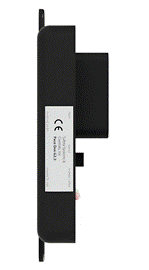
PACE-ONE G2 fits warehouses that need stronger control without tearing apart the fleet. The system supports forklifts, trucks, and tow tractors, and it works with both electric and internal-combustion equipment. It also supports broader site control through sensor integration, so speed can respond to operating conditions instead of staying fixed in every area.
That makes it useful for congested docks, choke points, aisle transitions, and facilities that need zone-based speed management rather than a one-setting approach.
What to Consider Before Installing a Forklift Speed Limiter System
A speed control project works best when you treat it as an operations decision, not just a product purchase. Start with traffic mapping. Find the choke points, blind corners, pedestrian crossings, dock approaches, and zones where loads shift most often. Then match the control logic to those locations.
You also need to check fleet mix, power type, operator behavior patterns, service access, and site rules. A forklift speed limiter should support the way your warehouse runs, not create new friction for maintenance or supervisors.
Look at these questions before rollout:
- Do you need one speed rule across the site, or zone-based control by risk level?
- Will the system need fault logging, tamper visibility, or sensor integration?
- Can the installation protect OEM wiring and fit the current fleet without long downtime?
We map site conditions before installation because a good policy still fails when the control points miss the actual risk areas.
Conclusion
A busy warehouse does not stay safe through signs, reminders, and operator memory alone. It stays safe when the equipment follows the same rule every time. A forklift speed limiter helps cut collision risk, lower tip-over exposure, protect racks and inventory, and keep traffic flow disciplined across shifts.
If your facility handles constant forklift movement, mixed traffic, and tight operating space, this upgrade deserves a serious look. Speak with our team and let us help you choose a system that fits your fleet, your layout, and your safety goals.
FAQs
1. Can a speed limiter be installed on older forklifts?
Yes, many older units can support a limiter if the vehicle condition and control system allow proper integration. Fleet age alone does not decide fit. Power type, wiring layout, and service history carry more weight during assessment.
2. Will a speed limiter slow down warehouse productivity?
Not in the way most managers fear. Poor driving creates more delay than controlled driving. Rack contact, blocked aisles, dropped loads, and investigations waste far more time than a managed travel speed policy.
3. Can warehouses apply different speed settings in different areas?
Yes. Many facilities use zone-based speed control so main travel lanes, pedestrian crossings, dock edges, and narrow aisles each follow different limits based on risk and traffic density.
4. Does a limiter affect manufacturer’s warranty?
That depends on the installation method. Systems that use OEM-grade connectors and avoid cutting factory wiring reduce the chance of warranty concerns and make fleet managers more comfortable with rollout.
5. Can a speed limiter work with other safety technologies?
Yes. Some systems can connect with sensors, access controls, or vehicle safety devices so speed responds to risk conditions, traffic zones, or other site rules instead of working as an isolated control.
